
How to Write a Way Better Story With Sensory Details


How to Write a Way Better Story With Sensory Details
Every writer wants to unlock the secret to helping readers disappear inside their story.
How do you draw them into your world? How do you engage their emotions and seize their attention so they lose all sense of time and space? How does a mere mortal cast such powerful spells?
There are a lot of skills at play, from compelling character development to crafting killer tension. But one of the mightiest and most misunderstood tools is descriptive language.
The right sensory details can hack into your reader’s brain and make them feel as if they’re the ones fleeing rabid wolves or falling in love. And I don’t mean that metaphorically. There’s actual brain science to back that up.
So what do you say we take a closer look at sensory details and how you can use them to write an unputdownable novel? And just in case you have a little trouble getting started, I’ll throw in a list of sensory language examples to help you out.
What is Sensory Language?

Sensory words include any nouns, verbs, adverbs, or adjectives that tap into sensory perception. In other words, if it clarifies the way something looks, smells, sounds, tastes, or physically feels, it’s a sensory detail.
You probably already use this type of language in your descriptive writing. If you’ve described the crack of wood splitting or how the beach air smelled like salt and seaweed, you’ve used sensory details.
But to be clear, not all descriptive words are sensory. This is where a lot of new writers get tripped up. Sensory details are concrete; you can experience them physically through the senses. So this:
“The forest was eerie.”
…is not sensory imagery. You know what eerie means, but you can’t see, smell, hear, taste, or touch it. Now compare that to this:
“A thick mist gathered at her calves. In the darkness above her, a branch cracked under the weight of something heavy.”
We can see it and hear it. That’s sensory language. And here’s why it matters:
The Power of the Five Senses in Storytelling
.jpeg)
As we know, the five senses are sight, smell, sound, taste, and touch. It’s through these senses that we experience everything. Our proudest victories, swooniest moments, and saddest goodbyes all come with scents, sounds, and textures that deepen and define our emotions.
And if it’s true for us, it’s true for our characters and our readers.
We know from actual factual scientific studies that when we read sensory details, our brains process that information as if we were experiencing it for ourselves.
That’s why vivid descriptions don’t just paint a strong mental image; they actually create an emotional reaction. When you incorporate sensory details into your story telling, you ramp up reader engagement by tapping into their feelings. You essentially invite them to experience the story for themselves.
As a bonus, adding sensory details often ensures more specificity in your descriptive writing. The more specific your imagery, the clearer the picture becomes in the mind of the reader, enabling them to connect with your story on a deeper level.
All these perks are the exact reason the number one piece of writing advice is “show, don’t tell.”
What is “Show, Don’t Tell”?

“Show, don’t tell” is the literary golden rule telling you to help your readers experience the story instead of simply explaining it to them.
This is telling:
“The garden was exquisite.”
That’s just me reporting on vibes. There are no sensory words, which, as we know, means there’s nothing the brain can use to actually feel the vibes.
This is showing:
“Wisteria branches framed the stone path in a canopy of lilac and filled the air with the scent of honey.”
You don’t need me to tell you it’s exquisite, right? You can see and smell for yourself.
Now, sensory writing is not the only way to exercise the “show, don’t tell” rule. But it’s a pretty major one. You can explore other strategies here or go even deeper with our in-depth “show, don’t tell” course in DabbleU Academy. (If you’re not already an Academy member, you’ll want to check it out. We’re talking monthly live workshops, weekly events, access to self-guided courses, and more.)
In the meantime, let’s go over some key strategies for adding sensory details to your story.
Tips for Using Sensory Details in Creative Writing

It’s not enough to toss some sensory words into your manuscript. If you want to snag your reader’s attention and stir their soul, you’ve got to be deliberate with your descriptive writing.
What specific impact are you trying to achieve with your vivid language? How do you want your audience to feel? What do you want to reveal about your characters or conflict?
Your storytelling goals should always influence your writing style, including the way you tackle imagery. The tips below will help you write compelling descriptions that enhance your story instead of distracting from it.
Describe With Purpose
Above all else, your sensory details should serve the narrative.
In school, we learned that the goal of descriptive writing is to help the reader visualize what’s going on. And, yeah, that’s a pretty important part of it. But in fiction writing—or any kind of writing, really—the first step is to ask yourself what that description does for the story.
Some great reasons to bust out those sensory details include:
- Establishing a mood (“...starlight glittering on the water’s surface…”)
- Creating a sense of character (“...a tidy bob and a voice that squeaked like an angry mouse…”)
- Dropping relevant details about the setting (“...always smelled of formaldehyde and cigarettes…”)
- Ramping up tension (“...a drop of sweat streaked down his face as the bomb ticked faster…”)
- Revealing character relationships (“...their spines straightened and stiffened at the sight of one another…”
- Any other version of showing something you’d otherwise have to tell the reader about
Bad reasons to write descriptive passages include:
- Showing off your sensory language skills
- You know you’re supposed to describe something so you’ll just go ahead and describe this
Before you start spinning a lot of beautiful sentences designed to engage your reader’s senses, ask yourself what those descriptions do to advance the story or create a sense of place.
Make It Subjective

Let the point-of-view (POV) character inform the sensory details you include.
If you’re writing in first person, the POV character is the narrator. If you’re writing in third person, the POV character is the character whose thoughts and feelings your narrator has access to.
That character’s personality, perspective, struggles, and emotions should impact the way you describe the moment.
Let’s say your POV character is waiting to be called in for an interview and they don’t feel they deserve the job. Factoring their state of mind into the sensory details, you might write it something like this:
“Bernard sat holding his portfolio in both hands—a burgundy Italian leather portfolio his grandmother bought him for graduation, probably hoping it would one day hold more than a barista’s resume. No such luck. Between its buttery panels rested a single sheet of paper, its face only full because of the bloated mission statement that consumed a third of the page.”
This passage could have talked about the texture of the carpet or the taste of Bernard’s coffee, but it skips all that to show us the slim resume sandwiched inside an elegant portfolio. It tells us a lot about Bernard’s state of mind and does it much more effectively than saying, “Dude had imposter syndrome.”
(We believe in you, Bernard.)
Make Emotion Concrete
Trying to stir your reader’s emotions by telling them how much your characters feel their feelings is a rookie mistake. Your audience won’t respond to abstract words like “devastated” or “enraged.” At least, they won’t respond as strongly as they will to sensory words.
You might describe how a character behaves, like showing their trembling hands or toothy grin. You can also draw the reader into your character’s emotional state by describing things through the character’s point of view, like we talked about in the last tip.
Another option is to share the physical sensations your character experiences because of their feelings. Does their stomach flop? Does the back of their neck get hot? Does their body feel heavy?
Don’t Depend on Your Sight

We tend to rely on visuals a lot when it comes to sensory details, but remember, we’ve got all five senses to work with. And it’s by incorporating all of them that we can create a three-dimensional experience for our audience.
That’s not to say you have to touch on all five senses every time you describe something. It’s just that you can really spark your reader’s interest by offering them the kind of scene information they don’t get as often. Textures, tastes, scents… that sort of thing.
Keep in mind: scent is a particularly powerful trigger for memory and emotion. It’s an excellent detail to bust out when you really want to stir your audience’s feelings.
Don’t Go Overboard
You don’t have to describe everything, and too many sensory words can really slow the pace of an otherwise great story. Not to mention, you’ll overwhelm the reader if you give them too many details to imagine.
If you’re not sure which images deserve to be included, go back to that original question of purpose. What do you need to accomplish, and which details can help you do that?
Then, zero in on one detail that fulfills your specified purpose perfectly. For example, if you want to convey that your character’s best friend is angry, you might decide to show the friend’s stony silence.
From there, you can layer on a few related details. Maybe they pause before they speak or talk in a lower tone than usual. Maybe they laugh through their nose and look away when the POV character says something annoying.
This layering approach helps you focus your sensory details so you’re not stuck trying to figure out if it’s important to mention that the friend is wearing bootcut jeans.
Sensory Language Examples

Even the most seasoned writer’s brain can completely shut down when the time comes to craft vivid descriptions. So here are some examples of sensory details to inspire your own writing process.
Sight Sensory Words
- Billowy
- Dark
- Disheveled
- Glare
- Glimmer
- Hazy
- Iridescent
- Pale
- Ripple
- Shadow
- Sheer
- Sparkling
Smell Sensory Words
- Antiseptic
- Floral
- Foul
- Garlic
- Metallic
- Jasmine
- Perfume
- Pungent
- Sandalwood
- Smoky
- Spice
- Sugary
Sound Sensory Words
- Bellow
- Boom
- Chirp
- Crackle
- Fizzing
- Melody
- Piercing
- Rasp
- Shriek
- Silent
- Snap
- Trill
Taste Sensory Words
- Acidic
- Bitter
- Butter
- Cinnamon
- Creamy
- Juice
- Earthy
- Fishy
- Medicinal
- Oaky
- Salty
- Spicy
- Stale
- Sweet
- Tart
Touch Sensory Words
- Balmy
- Brittle
- Burn
- Caress
- Cool
- Frigid
- Grasp
- Jab
- Powdery
- Slippery
- Sticky
- Sweltering
- Velvet
- Vibration
I Sense a Great Novel in Your Future…
Now that you’ve mastered all the different senses in your writing, it’s time to put your new skills to work in your novel.
Want a little support as you continue to advance your skills?
Join us in DabbleU Campus! This online community is free to join and filled with writers who are eager to connect with you as you grow in the craft together.
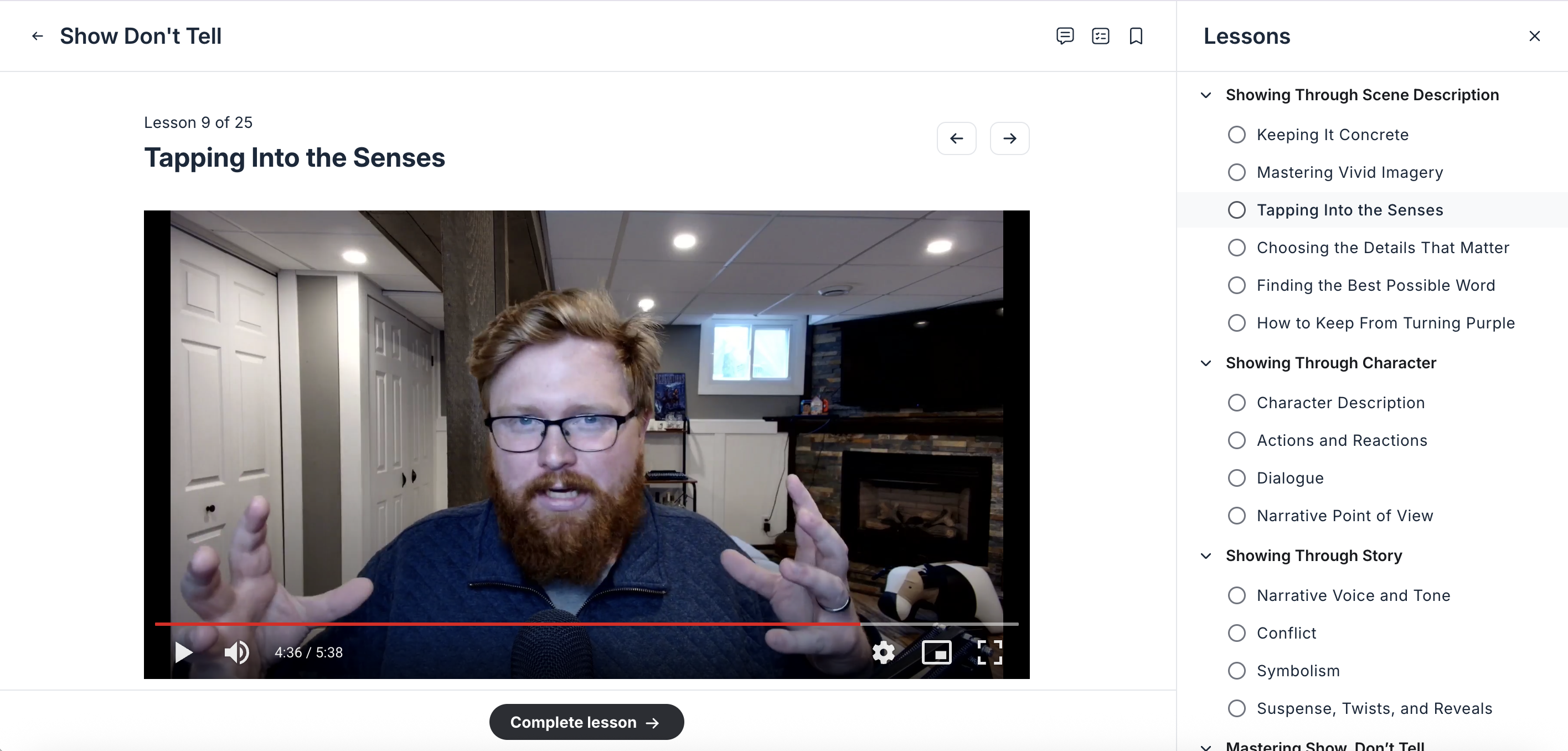
If you really want to master sensory details and other descriptive writing, we have an entire self-paced course on show, don’t tell that will seriously make you an expert by the time you’re done. You can get access to that course and others, plus monthly live workshops, weekly events, an exclusive community of authors like you, and over 50 hours of workshop recordings with DabbleU Academy.
You can even try the Academy before you commit! Sign up for a free 14-day trial of the Dabble writing tool (no credit card required), and you’ll also get access to the DabbleU Academy and all its perks for the length of your trial.
SHARE THIS:


TAKE A BREAK FROM WRITING...
Read. Learn. Create.

What's the difference between direct and indirect characterization? And is one better than the other? Here are the answers you've been looking for.

Always wanted to know the secret to telling a good story? This guide lays it all out for you.

Discover the best writing tools for everything from brainstorming and organizing to drafting, revising, and managing your time.