
What is Falling Action? The Secret to a Satisfying Story

Once upon a time, there was an aspiring author who couldn’t define falling action. They thought they had an instinctive understanding of good story structure, but then a fellow writer read their manuscript and said their falling action “felt rushed,” and the author had no idea what that meant.
Eager to improve their craft, the aspiring author ran through the streets, asking random townsfolk if they knew the meaning of this cryptic term. People shrugged or scrunched their eyebrows together or suggested it might refer to a particularly dramatic tumble. No one had the answer.
In a final, desperate attempt at clarity, the aspiring author asked the internet for the definition of falling action. The search results revealed this article, and with trembling fingers, they clicked, finally revealing the truth.
Then they made their story better. The end.
See how abrupt that ending was? How it completely undercut the tension and high stakes I worked so hard to build in this riveting tale? That’s because I skipped the falling action.
Fortunately, you’ll never make that mistake. Not after reading this article.
We’re about to discuss everything you ever wanted to know about falling action, why it matters, and how to write it well.
What is the Falling Action of a Story?

Falling action begins immediately after the climax and continues until the story’s final resolution. Its purpose is to release the tension you built up in the rising action and brought to its highest point in the climax.
This is also where you tie up any loose ends, resolving minor plot lines, show the consequences of the characters’ actions during the climax, and allow them to process everything they just endured as they establish their new normal.
In epic fantasy, the falling action is often the journey home after the final battle. Everyone’s a little bruised and stunned, and they’re going to have to do a little work to reach a place of stability, but the worst is behind them.
The same is true in all versions of falling action; sometimes it’s just a metaphorical journey home.
Your characters might still encounter new conflicts at this point in your story, but they’ll be minor conflicts compared to the massive challenges they’ve already overcome. Return of the King is a great example of this. The climax of The Lord of the Rings trilogy (the books, not the movies) occurs with the destruction of the One Ring, but even once the gang has done that, the hobbits have to fight the Battle of Bywater to reclaim their home.
Where Falling Action Lands in the Narrative Structure
I know it seems like we just answered this. Falling action occurs between the climax and the resolution, also known as the dénouement.
But you can’t fully appreciate how essential this element is until you look at it in the context of the full narrative structure. Allow me to introduce…
Freytag’s Pyramid, but Not Really
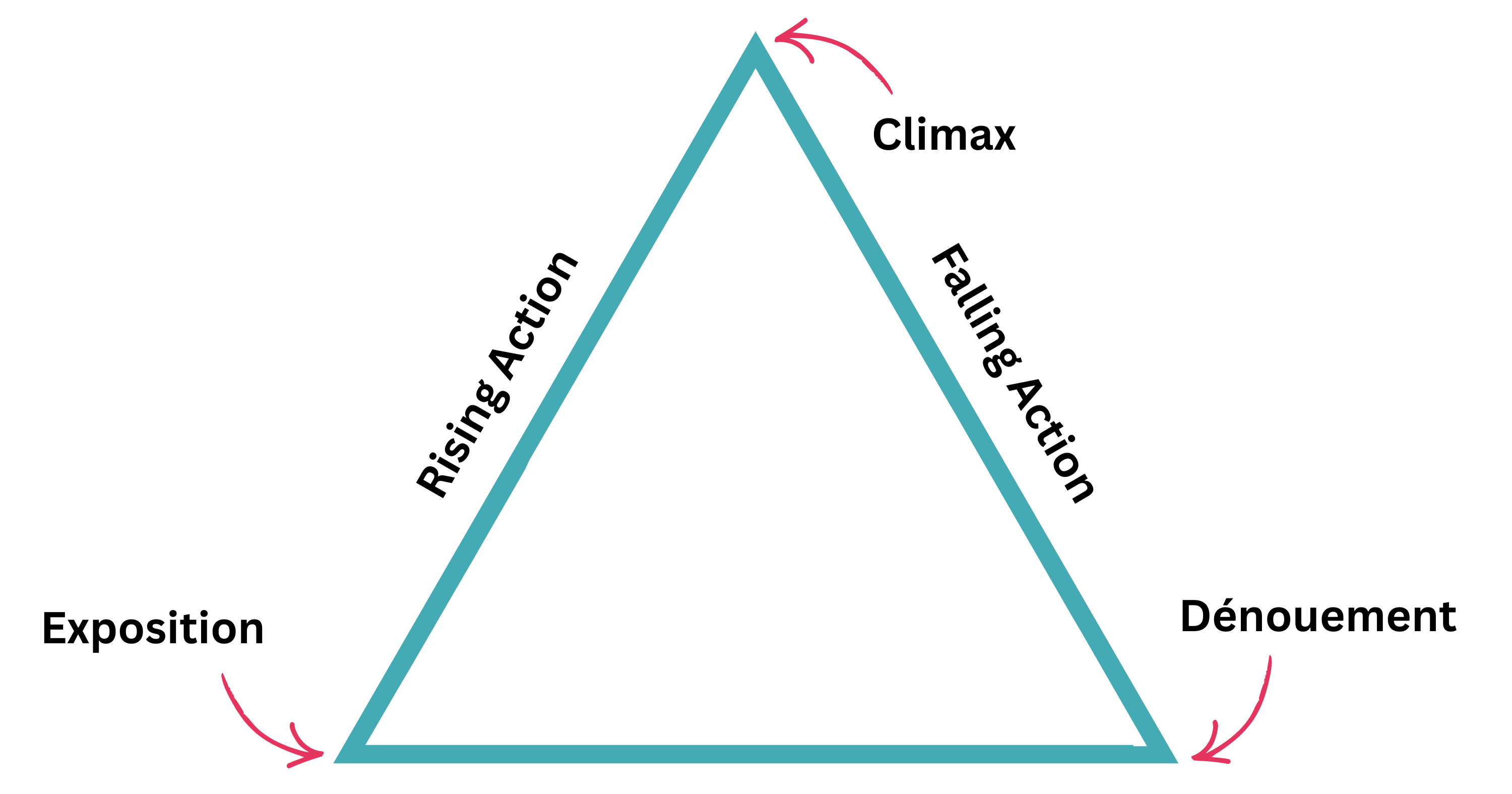
Gustav Freytag was a 19th-century German playwright who outlined the basic plot structure now known as Freytag’s Pyramid. This is often used as a tool for explaining falling action, but… well, it’s complicated.
See, the way we often talk about Freytag’s Pyramid in modern writing doesn’t quite match the explanation he laid out. We don’t have time to get into the differences here, so I’ll focus on explaining the version of the pyramid that you’re most likely to encounter when folks explain falling action.
Not-Freytag’s Pyramid features five stages:
- Exposition - The setup for the story, introducing the characters in their normal world, then introducing the inciting incident that hurls them into the conflict
- Rising action - A steady increase in narrative tension as the external conflict intensifies and the characters confront their internal conflicts
- Climax - The peak of tension and the turning point where the protagonist makes their most daring decision
- Falling action - The immediate aftermath of the climax, where all that built-up tension eases and characters move toward a resolution
- Dénouement/resolution - The resolution, which shows the long-term impact of the conflict
Super basic story stuff. The main characters engage in a conflict, the conflict gets worse, things get more tense, then there’s a big battle and things mellow out as the characters find their way to a new kind of stability.
You’ll see some version of this arc in nearly every story structure, from the three-act structure to Save the Cat! In this arc, the falling action serves as an essential winding down period. It gives both reader and characters a chance to slow down and digest everything that just happened.
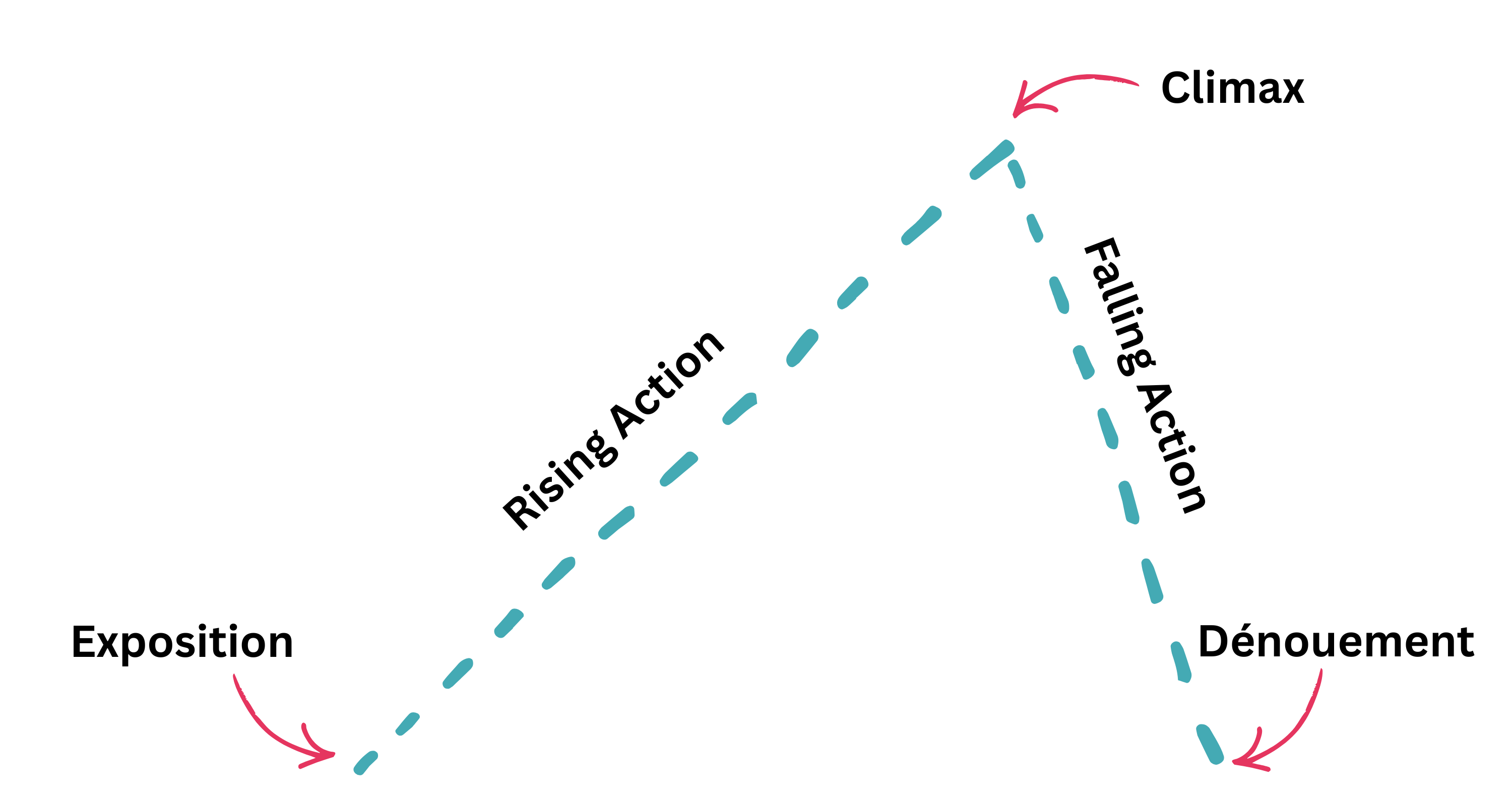
Just keep in mind that while the falling action brings us back to earth after the rising action blasts us to the top of tension mountain, it’s not a symmetrical slope. Rising action takes up a huge chunk of your story, while falling action typically accounts for 5-10% of the story.
Falling Action vs. Denouement
It’s very easy to confuse falling action with dénouement. Sometimes they blur together, with the falling action leading to the dénouement in the same scene. Then, to make things more complicated, different plot structures apply these terms in different ways. In the three act structure, for example, “dénouement” refers to both the winding down phase and the final resolution.
For the purposes of this article, falling action and dénouement are two different things. The falling action is the journey from the climax to the resolution, while the dénouement is the resolution.
In The Wizard of Oz, Dorothy waking up in Kansas and declaring her love for home is the dénouement. Her journey has come to an end, and we see the long-term effect: a deeper appreciation for home.
The falling action is the part right after the climax (killing the witch), when Dorothy and friends journey back to the Wizard, collect their rewards, and discover that the Great and Powerful Oz is just a balloonist from Nebraska. This sequence is a bridge between the climax and the story’s resolution.
And why do we need a bridge, you ask?
Why is Falling Action Important?

You (usually) need falling action to tell a compelling story your readers will still be talking about after the final page. But why? What does it do that’s so essential?
The first and most basic answer is that it’s what we’re used to. Nearly every great story has a falling action sequence, and when it’s missing, something feels off, even if we can’t put our finger on what the problem is.
There is an exception to this. Some authors omit falling action deliberately, strategically, and successfully, but we’ll get into all that later.
For now, here are some strong arguments for why your novel should probably include this story beat:
Falling Action Serves as a Transition
Story endings that go straight from, “She stabbed the beast through the heart” to “And they all lived happily ever after” tend to feel abrupt. Probably because life doesn’t work that way. There’s a period of processing and rebuilding, even after victory. That’s falling action.
It Provides Closure
Your reader has been through a lot by the time the climax ends. They’ve seen your characters at their best and worst. They’ve stood by them through their biggest mistakes, cried over their losses, and believed in them even when the odds were stacked against them.
Your readers deserve closure. Falling action is where they get it.
This is where you answer lingering questions, like “How will this impact the sisters’ relationship?” and “Will the villagers finally appreciate the hero?” and “Is the mentor really dead?”
Pro Tip: The Dabble Plot Grid is amazing for making sure you bring all your story threads to a satisfying conclusion. Add all the columns you need to track character arcs, subplots, and more. If you don’t use Dabble, you can try it for free for 14 days by clicking here.
Falling Action Shows Character Development
The falling action gives the characters time to process the climax, the events leading up to the climax, and the choices they made along the way. This is when we get to see the lessons they take away from the experience, and it serves as a conclusion to their character arcs.
The falling action of The Hunger Games cements Katniss’s transition from an individualist focused only on her own family’s survival to the emerging leader of a rebellion. We see how she is now permanently thrust into the limelight, forced to present an image that will placate the Capitol while the desire to rise up against them grows within her.
It Engages the Reader Beyond the Climax

We tend to think of the big, action-heavy moments as the key to reader engagement. But remember, our audiences aren’t just looking for drama. They want connection and closure, too.
Your falling action keeps the reader engaged by giving meaning to everything they just witnessed. You’re showing them how the conflict has altered these characters and the world they live in, and that insight creates a deeper connection between your reader and story.
It Drives Home the Theme
The falling action is where your story’s theme—its core message—really lands.
See, your theme lines up with your protagonist’s internal conflict. When Katniss is forced into a kill-or-be-killed situation with other innocent youth, she’s also forced to wrestle with the contradictions between her need to survive for the sake of her family and basic human empathy for her competitors.
Your story’s climax is where the protagonist picks a side in their internal conflict. In Katniss’ case, she gambles on vulnerable collaboration over individual survival. We see this when she and Peeta threaten to Romeo-and-Juliet themselves rather than fight to the death.
The falling action then shows the consequences of the climax, and those consequences serve as a conclusion on the theme. The Capitol allows both Katniss and Peeta to live, the public becomes enamored with their supposed love for one another, and they seem to have lit a small spark of rebellion in the hearts of a population that had lost hope.
The message is that our power lies in our capacity for compassion and unity.
Is Falling Action Mandatory?
With all these perks, it would seem that it’s crucial to write falling action in all your stories. And yeah, it usually is.
That said, there are times when authors opt out of falling action. Because this plot point is so common, omitting it can be a shock to the system, especially when the author ends on a particularly jarring climax.
Ending on the climax leaves the reader without closure. There’s no emotional relief and no clarity about what comes next for the characters they’ve come to care about. All they can do is sit there in shock and devastation. If that’s the impact you’re going for, ditching falling action can work. If you've seen Infinity War or read "The Lottery," you know what I'm talking about.
Keep in mind that this strategy carries the least amount of risk in short stories. Short fiction allows you to focus on one plot line, so you don’t run the risk of leaving a bunch of loose ends.
Examples of Falling Action

SPOILERS AHEAD!
Sorry. Examples are helpful for clarity, but it’s impossible to provide falling action examples without ruining the ending. I’ve stuck with super popular books and movies in the hopes that you’ve already seen them, but tread carefully.
Titanic
In Titanic, the climax occurs when the ship is struck by an iceberg and Rose and Jack choose to run/swim for their lives together.
This climax leads into the falling action, a sequence that includes Rose and Jack waiting for rescue after the ship goes down, Jack’s death, Rose letting go (immediately after saying she won’t), and Rose’s rescue.
These final moments together and Rose’s vow to hold on to what’s important to her solidify the life-altering power of their romance and lead us naturally to the story’s resolution: A much older Rose who’s lived a full life on her own terms and never stopped loving the dude she met on vacation.
The Hunger Games
In this story’s climax, Katniss and Peeta agree to both eat deadly nightlock berries rather than try to kill one another to win the games. The falling action that follows centers on how both the Capitol and the public respond to this.
There are interviews. There is widespread fascination with the star-crossed lovers who’d rather die together than kill each other. And there’s big pressure to uphold this image so the Capitol doesn’t suspect them of their true motive: Fury-fueled rebellion.
Cinderella
I want to talk about the super intense Brothers Grimm version, because there’s a lot more going on there.
The climax of this classic is the moment when Cinderella is finally brought out to try on the glass slipper, even after her father (oh yeah, he’s alive in this version) straight-up calls her “a deformed little Cinderella from my first wife.” The shoe fits and the falling action begins.
There’s no more tension, no more wondering if Cinderella will ever escape her miserable life. She’s riding off with the prince to her new future. Little white pigeons land on her, one on each shoulder, confirming that she is the rightful bride.
There’s just one more lingering question. What will become of those wicked stepsisters?
Cinderella’s devoted pigeons peck their eyes out, that’s what.
This falling action leads us to the resolution, where Cinderella lives happily ever after and her step-sisters do not.
Tips for Writing the Falling Action of a Story

After all that, you’re hopefully getting some ideas for how to nail your story’s falling action. But here are a few extra pointers just in case:
Start From the Climax
As the great philosopher Semisonic once said, “Every new beginning comes from some other beginning’s end.”
In the context of falling action, that means the falling action should be a new phase that occurs as a natural reaction to the climax and its conclusion. The events of the falling action should only be possible because the climax took place.
Resolve Inner and Outer Journeys
Remember, we’re bringing it all home at this point. That means working toward a resolution for the story’s main conflict as well as all those minor plot lines.
It also means you want to bring your protagonist’s emotional journey to a satisfying conclusion. It’s not just about making sure all the villains are vanquished and the lovers kiss. This is the time to show who your characters have become because of what they’ve experienced and how they feel about it.
Match the Length to Your Genre
I mentioned before that falling action typically accounts for 5-10% of the story, though it can be more or less depending on the author and genre.
Sometimes, the falling action moves quite quickly. Maybe after the grand gesture in the climactic scene, the lovers finally kiss, and the falling action only consists of them walking hand-in-hand down the street, bickering the way they did in their meet cute, before all the weirdness that tore them apart. In this one little conversation, we see that the rift has healed.
In other stories, the falling action stretches out much longer, particularly in fantasies where there is a literal journey home and a few obstacles to overcome along the way.
With such a wide range, your best bet is to study the most popular contemporary books in your genre and subgenre. They’ll give you a hint about what your readers are expecting and whether your falling action sequence might feel rushed or too drawn out.
Only Introduce Conflict That Demonstrates Growth
If it makes sense for you to write longer falling action that includes new obstacles, stick to conflicts that link the events of the climax to the ultimate resolution.
After the climactic reunion scene in Finding Nemo, Dory gets trapped in a fishing net. Nemo has an idea to free her, but it means he has to enter the net, too. This conflict forces Marlin to cement what he’s learned: He has to loosen his grip and trust his son to navigate risk himself.
So it’s a new problem, but it’s one that shows both readers and characters how Marlin has grown. It’s also easy to fix this problem before the story’s natural conclusion. That’s another rule for introducing obstacles in the falling action.
Plant Whatever You Need to Plant
Now let’s say you want to leave your story on a cliffhanger or set yourself up for a sequel. The falling action can be a great time to do it.
It’s not the only time you can do it. You might opt to slip a new revelation or twist into the dénouement. But the falling action is an option.
Common Mistakes in Writing Falling Action

Before we part ways, we should probably go over a few common errors writers make when it comes to falling action. If you can avoid these, you’ll be miles ahead of other new writers. (Not that it’s a competition.)
Rushing It or Dragging It Out
I know we touched on this, but the length of your falling action really can make or break your novel. It’s part of your story’s ending, which means it’s the taste your book will leave in your reader’s mouth.
A rushed resolution will leave your audience unsatisfied. A drawn-out one will have them abandoning ship before the final scene.
Unfortunately, I can’t tell you exactly how long is long enough. It really comes down to your genre and the needs of your specific story.
What I can say is that critique partners and beta readers are invaluable in this area. If they don’t feel you’ve given your story a satisfying end, they’ll tell you.
Introducing Major Conflicts
Again, it’s totally fine to introduce relevant obstacles in the falling action. What you don’t want to do is bring in a new conflict that sparks a big storyline you don’t have time to resolve in a believable way.
You can introduce a cliffhanger, but it’s usually best to do that after you’ve wrapped up all the storylines in this novel so the reader has a sense of closure and immediately recognizes that this is a cliffhanger. Then make the setup for your cliffhanger short, sweet, and shocking.
Pro tip: Cliffhangers that undo things in your story stink. They should introduce something for the next book.
Leaving Loose Ends
This is one of the more obvious errors, but it still happens. You’d be surprised how easy it is to leave plot points unresolved without realizing it. So be sure to make sure you’ve brought all your minor storylines to a tidy conclusion and you’ve wrapped up the emotional journeys as well as the external conflicts.
Again, the Dabble Plot Grid is the absolute best tool I know for making sure this mistake never happens.
Give Your Readers an Ending They Can’t Stop Thinking About
Don’t make the mistake of treating falling action like the stuff you have to get through to reach your story’s conclusion. Written well, this stage of your story can leave your reader feeling all the feels. It’s your last chance to connect with them and it gives them an opportunity to give a proper goodbye to the characters they’ve grown to love.
So make a genuine effort to write truly satisfying falling action. Once again, I have to recommend Dabble for this endeavor.
Not only can you create as many columns as you want to track different storylines on your Plot Grid, you also have the corresponding notes right at hand as you write each scene.
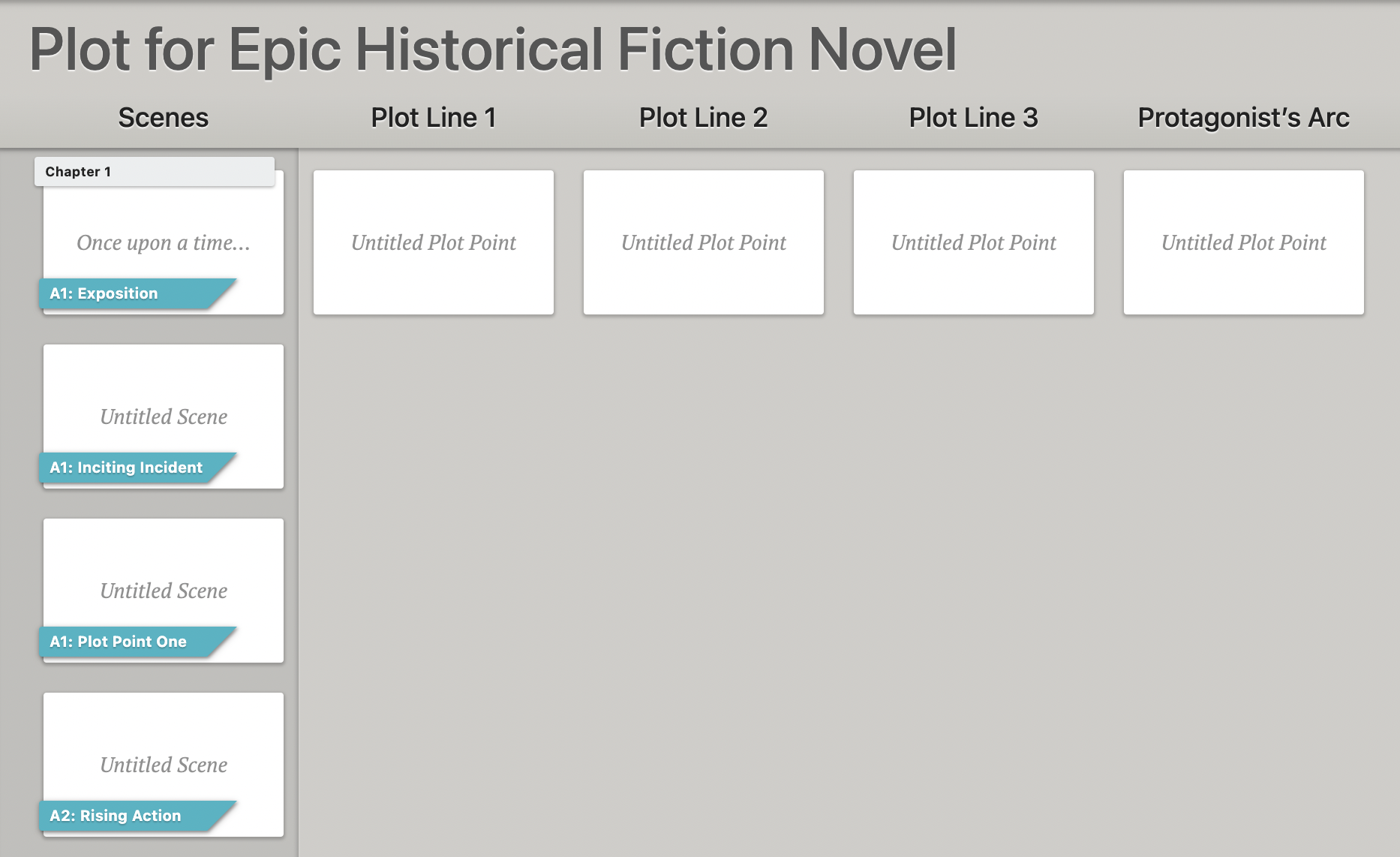
Pantsers will be delighted to learn that it works in reverse, too! Every time you write a new scene, a corresponding scene card appears in the Plot Grid. This makes it way easier to evaluate your overall plot structure after you’ve written your first draft.
To explore these and all Dabble’s other features, start a 14-day free trial here, no credit card needed.
SHARE THIS:


TAKE A BREAK FROM WRITING...
Read. Learn. Create.

What's the difference between direct and indirect characterization? And is one better than the other? Here are the answers you've been looking for.

Always wanted to know the secret to telling a good story? This guide lays it all out for you.

Discover the best writing tools for everything from brainstorming and organizing to drafting, revising, and managing your time.